
AIM Act Refrigerant Phasedown: A Florida Contractor’s Guide
The refrigerant landscape is shifting in a way that most HVAC and refrigeration contractors in Florida can no longer plan around. The AIM Act phasedown is scheduled, it’s stepped, and it doesn’t end until 2036. Production allowances for hydrofluorocarbons drop every few years, meaning the R410A and other HFCs that have been your supply chain staples for the past decade are getting progressively harder to source at the prices you’re used to.
This guide covers the full timeline, explains how HFC allowances work and why your supplier’s regulatory standing matters, walks through the transition refrigerants, and gives you a practical read on what to do with surplus and recovered refrigerant as the phasedown tightens. If you’re managing an active HVAC or refrigeration contracting operation in Florida, this is information that belongs in your planning cycle.
What the AIM Act Actually Does
A Phasedown, Not a Phaseout
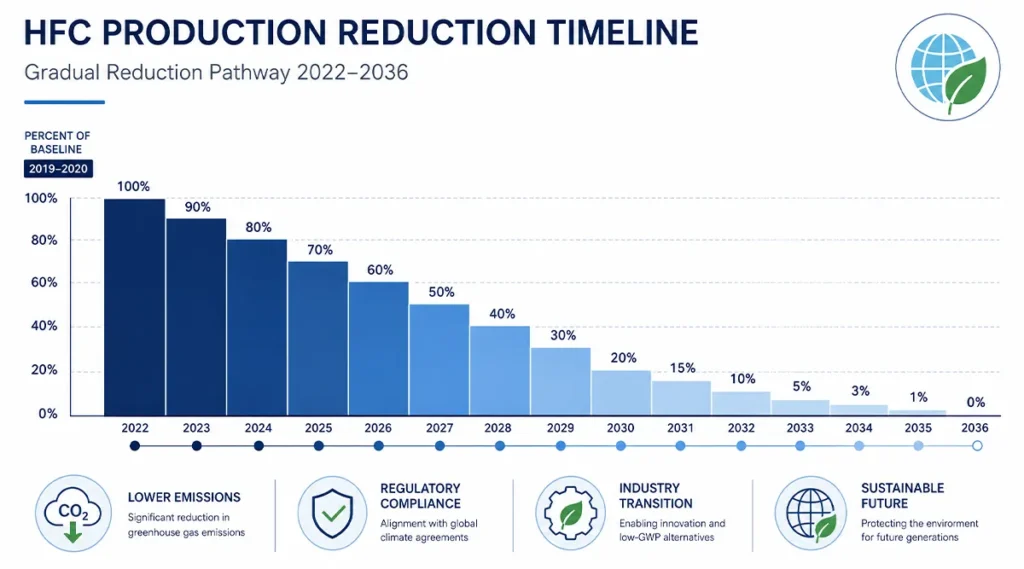
The American Innovation and Manufacturing Act, signed in 2020, gave the EPA authority to restrict HFC production and imports. Unlike the HCFC regulations that phased out R22 and similar refrigerants entirely, the AIM Act is a phasedown: production doesn’t go to zero, it settles at 15% of the 2022 baseline by 2036 and stays there. HFCs remain legal to buy and use, so there’s no hard cutover date forcing you to replace existing equipment, but as production allowances shrink, costs rise and procurement gets more complicated.
Why HFCs Got Targeted
Hydrofluorocarbons replaced HCFCs for all the right reasons at the time. R22 depleted the ozone layer; HFCs didn’t. The problem turned out to be global warming potential. R410A, the dominant residential HVAC refrigerant for the past two decades, carries a GWP of 2,088, which is more than 2,000 times the warming impact of CO2. The AIM Act’s goal is to shift the industry toward lower-GWP alternatives while keeping the transition gradual enough that it doesn’t disrupt the refrigerant supply chain the industry depends on.
What the EPA Regulates Under the AIM Act (and What It Doesn’t)
EPA authority covers production and import allowances, technology transitions for new equipment, and proper management of HFCs already circulating in the system. What’s explicitly carved out: recovered and reclaimed refrigerant. Reclaiming HFCs already in circulation and returning them to specification doesn’t count against production allowances, which is why EPA-certified reclaimers play a meaningful role in how the industry manages supply as the phasedown progresses. Contractors looking to sell surplus refrigerant through a buyback program benefit directly from this exemption.
The HFC Phasedown Timeline, Step by Step
2022 to 2023: The Baseline and the First Cut
The AIM Act used 2022 production and import levels as its baseline. Starting from there, allowable production in 2022 and 2023 was set at 90% of that baseline, a 10% reduction from the starting point. This initial step was intentionally modest, designed to signal direction without disrupting supply chains before the industry had time to prepare.
2024 to 2028: The 40% Reduction (Where We Are Right Now)
Production dropped to 60% of baseline starting in 2024, and that’s where it stays through 2028. For Florida contractors, this is the window where procurement planning starts to matter in ways it didn’t a few years ago. Refrigerant is still available, though prices reflect the supply constraint, and the contractors feeling it most are the ones relying on last-minute, spot-price purchasing. Building supplier relationships before the 2029 step-down is worth considerably more than it might seem right now.
2029 to 2033: The Deep Cut to 30%
When 2029 arrives, allowable production drops to 30% of baseline, a 70% total reduction from the 2022 starting point. This is the step that reshapes procurement at scale. Contractors specifying large R410A equipment installations today should be asking whether those systems will have adequate service refrigerant at reasonable cost in 2031 and 2032. The 2029-2033 window is where the economics of HFC-dependent equipment age noticeably faster, so the planning window for transitions you’d normally defer is shorter than it looks.
2034 to 2035, Then 2036 and Beyond
Production allowances drop to 20% of baseline for 2034 and 2035, then settle permanently at 15% from 2036 onward. That’s an 85% total reduction from where the industry started. By that point, most new equipment installations will be running lower-GWP alternatives, and HFC supply will exist primarily to service the long tail of older equipment still in operation. The refrigerants don’t disappear; they just become scarce and expensive relative to what the market has historically absorbed.
The Rule That Took Effect January 1, 2026
The phasedown runs in the background of your procurement decisions. A more immediate compliance item landed in January 2026: the EPA’s HFC Leak Repair and Management Rule, which took effect January 1. If you operate or service HFC refrigerant systems with a charge size of 15 pounds or more, documented leak detection and timely repair is now a federal requirement. For contractors doing commercial and industrial work, the 15-pound threshold is easy to hit, and for chillers or large split systems, you’re often well above it.
The rule layers on top of existing EPA Section 608 requirements rather than replacing them, so if your documentation practices are current for 608, the 2026 rule is an extension of that workflow. Enforcement scales with charge size and how long a known violation goes unaddressed, so it’s worth reviewing your service records for any commercial accounts running qualifying systems. See EPA’s AIM Act resources for current leak management guidance.
How HFC Allowances Work and Why Your Supplier’s Standing Matters
What an Allowance Holder Actually Is
The EPA distributes HFC production and import allowances to a defined list of companies. Those allowances represent the legal right to produce or import a specific quantity of HFCs in a given year. Without them, a company can legally sell reclaimed refrigerant from existing supply, but they can’t sell new HFC production. As the phasedown tightens and allowances become more valuable, the companies actually holding them get fewer, and the broker chains connecting buyers to authorized production get longer and harder to verify.
Why This Should Change How Florida Contractors Source
Buying from an allowance holder means your supply traces directly to EPA-authorized production, not through a broker chain that may or may not reach back to legitimate sourcing. For contractors whose own compliance documentation might ever be reviewed, a supplier with a clean regulatory standing is worth more than the marginal savings on product of unclear origin. American Refrigerants holds HFC allowances under the AIM Act, ranking in the top 200 nationally. That’s not a marketing position; it’s a compliance record that exists in EPA documentation.
Where Reclaimed Refrigerant Fits the Supply Picture
Reclaimed refrigerant, product that’s been recovered, processed back to AHRI 700 standards through independent laboratory certification, and returned to specification, doesn’t count against production allowances. Buying reclaimed product is legally equivalent to buying new for most service applications, and as new HFC production drops, the reclaimed supply becomes a real buffer for contractors who need product and need to source it compliantly. The reclaimed market won’t fully offset production cuts at scale, but it cushions supply in ways that matter when you’re trying to service a fleet of existing R410A equipment through the 2029 step-down.
What’s Replacing R410A: Transition Refrigerants for Florida HVAC
R-454B Is the Primary Replacement for Residential and Light Commercial
The refrigerant that HVAC equipment manufacturers are designing new systems around is R-454B, sold under the brand name Opteon XL41 by Chemours. Its GWP is 466, roughly 78% lower than R410A, which satisfies the direction the AIM Act is pushing. New equipment built for R-454B has been hitting the market since 2025, and that’s the path for new installations going forward.
What the A2L Classification Means for Florida Technicians
R-454B is classified as an A2L refrigerant, meaning it’s mildly flammable under specific ignition conditions. That classification changes things operationally. Technicians servicing or installing equipment with R-454B need training on A2L handling requirements, and the equipment itself must be rated for A2L use by the manufacturer. Retrofitting existing R410A systems is generally not viable. The A2L classification doesn’t mean R-454B behaves like propane or natural gas under normal service conditions, but it does change installation procedures, ventilation specs, and detector requirements in ways that require preparation before you’re on-site with it.
What Happens to Your Existing R410A Systems
No regulation forces decommissioning of functioning equipment on a fixed timeline. R410A systems installed today will run until they’re due for replacement, and service refrigerant will still be available for them, at prices that reflect constrained supply. For contractors managing large commercial R410A fleets, the practical question isn’t when R410A becomes illegal but at what point the cost of servicing aging R410A equipment makes transition to R-454B systems the financially better decision. That calculation shifts meaningfully as the 2029 step-down approaches, so the planning window for that conversation with commercial customers is narrower than the 2036 headline date suggests.
What to Do With Surplus and Recovered Refrigerant in Florida
Recovery Is Already a Federal Requirement
EPA Section 608 regulations require proper recovery before servicing or decommissioning any refrigerant-containing equipment. Every pound of refrigerant vented to atmosphere from a system you’re decommissioning is a violation, and with HFCs under increased scrutiny through the AIM Act, enforcement priority on venting violations is moving in one direction. Proper recovery isn’t an add-on service; it’s baseline compliance for any licensed contractor working on refrigerant-containing systems. Partnering with a full-service provider that handles refrigerant recovery services removes the compliance burden from your crew on decommissioning jobs.
Selling Recovered Refrigerant Through a Buyback Program
Once refrigerant is recovered, it has real market value. Selling it through a buyback program turns product sitting in tanks on your property into payment rather than a storage and disposal problem. American Refrigerants buys recovered HFCs from Florida contractors, with payment issued within 30 days for recovered product. If you’ve got virgin refrigerant in sealed, original manufacturer containers, those cylinders can often move faster because they’re eligible for direct resale without reprocessing.
Mixed and Contaminated Gas Has More Options Than You Might Think
Mixed refrigerant cylinders happen on large jobs and rushed teardowns, pulling different types into the same recovery cylinder. Mixed gas can’t be legally resold or returned to service without separation, so the standard assumption is that disposal is the only path. It usually isn’t. Fractionation separates a mixed load back into its component refrigerants, which can then be reclaimed and returned to the supply chain. American Refrigerants handles in-house fractionation rather than sending mixed loads to a third party, which keeps the process faster and the chain of custody clean. If you’re sitting on cylinders you’ve written off as a disposal cost, it’s worth a call before committing to that.
Staying Compliant Through the Transition: What to Track
Know Your System Inventory and Charge Sizes
The 15-pound threshold from the January 2026 leak management rule is the first number to know. Commercial split systems, chillers, and large refrigeration units hit that threshold easily. For contractors managing commercial accounts, maintaining a current record of refrigerant type, charge size, and last service date is what compliance documentation looks like when someone asks for it. If you’re already doing this for 608 compliance, the 2026 rule extends that documentation requirement; it doesn’t replace it.
Verify Your Supply Chain’s Regulatory Standing
As production allowances shrink, the secondary refrigerant market gets noisier. Product of unclear origin, sold through broker chains that don’t trace back to authorized production, isn’t a legal gray area under the AIM Act. Sourcing from an EPA-certified reclaimer or confirmed allowance holder gives your own compliance record a clean paper trail, which matters more in audit scenarios than most contractors anticipate until they’re in one. The price differential on less-documented product rarely covers the exposure.
Build a Regular Cadence for Moving Recovered Product
Recovered refrigerant sitting in cylinders on your property is both a potential compliance liability and an opportunity cost if it’s saleable. Building a regular cadence for selling back recovered product keeps your inventory documented, generates payment that offsets purchasing costs, and removes product from your responsibility chain. The contractors best positioned through the phasedown tend to have the cleanest inventory records and the most reliable supplier relationships, not just the largest stockpiles.
Questions Florida Contractors Ask About the AIM Act
What refrigerants are covered under the AIM Act?
The AIM Act covers hydrofluorocarbons as a class. That includes R410A, R404A, R134a, R507A, R407C, and other HFCs used across residential HVAC, light commercial, and industrial refrigeration. R22 and other HCFCs were phased out under separate Montreal Protocol regulations and aren’t part of the AIM Act. The lower-GWP alternatives like R-454B and R-32 are products of the transition the AIM Act is driving, not refrigerants being phased down.
Is R410A still legal to buy and use in Florida?
Yes. The AIM Act restricts production and import of HFCs; it doesn’t prohibit buying or using refrigerant already in the supply chain. R410A remains available for service of existing equipment and will continue to be for the foreseeable future. What changes is price and availability as production allowances decline. Planning your service business around R410A staying at current pricing through the 2029-2033 window isn’t a safe assumption, so getting ahead of that in your equipment recommendations to customers is worth doing now.
Do I have to replace my R410A equipment on any fixed timeline?
No current regulation requires replacing functioning equipment by a specific date. New residential and light commercial HVAC systems are being manufactured around R-454B starting in 2025, but existing R410A installations run until they’re replaced on their normal cycle. The realistic question for contractors isn’t when you’re legally required to replace, but when the total cost of service on aging R410A equipment makes replacement to lower-GWP systems the financially better decision. That break-even point moves closer as service refrigerant pricing reflects the phasedown.
What is the exact HFC phasedown schedule?
The AIM Act used 2022 as the production baseline. The step-down schedule: 2022-2023 allowed 90% of baseline production. 2024-2028 allows 60% (where we are now). 2029-2033 drops to 30% allowable. 2034-2035 drops to 20%. From 2036 onward, the cap is 15% of baseline permanently, an 85% total reduction from 2022 levels when the phasedown reaches its floor.
What is the difference between a refrigerant buyer and an EPA-certified reclaimer?
A general refrigerant buyer may accept recovered product and resell it or send it to a third-party reclaimer for processing. An EPA-certified reclaimer is specifically authorized by the EPA to process used refrigerant back to AHRI 700 standards, verified through independent laboratory testing, and return it to the market as certified reclaimed product. That distinction matters for compliance documentation and for the value you get on recovered refrigerant you’re selling. Reclaimed product from an EPA-certified reclaimer is legally equivalent to new production for most service applications.
What happens if I accidentally mix refrigerants during recovery?
More common than most contractors want to acknowledge, especially on large jobs. Mixed gas can’t be resold or reused without separation, so disposal is usually the default assumption. It often doesn’t need to be. Fractionation separates a mixed load back into its individual component refrigerants, which can then be reclaimed and returned to the supply chain. Call us at (941) 371-0300 before committing to disposal costs. Depending on what’s in the cylinders and the quantity, fractionation may be a better option.
How do I sell recovered refrigerant to American Refrigerants from Florida?
Call (941) 371-0300 or use the inquiry form on the buyback page. Recovered refrigerant is paid within 30 days of receipt and processing. Virgin refrigerant in sealed, original manufacturer containers can move faster because those cylinders are often eligible for direct resale. Refrigerant type, quantity, and your location are the main factors we’ll ask about upfront, so having that information ready makes the first call more efficient.
Ready to Move Your Surplus Refrigerant?
American Refrigerants is an EPA-certified reclaimer and AIM Act Allowance Holder based in Bradenton, FL. We buy recovered HFCs, handle on-site recovery services, and operate in-house mixed-gas fractionation for cylinders that can’t be resold as-is. Whether you’ve got surplus refrigerant sitting in your shop, a job coming up that needs recovery support, or questions about sourcing reclaimed refrigerant compliantly, call (941) 371-0300 or get a buyback quote using the button below.