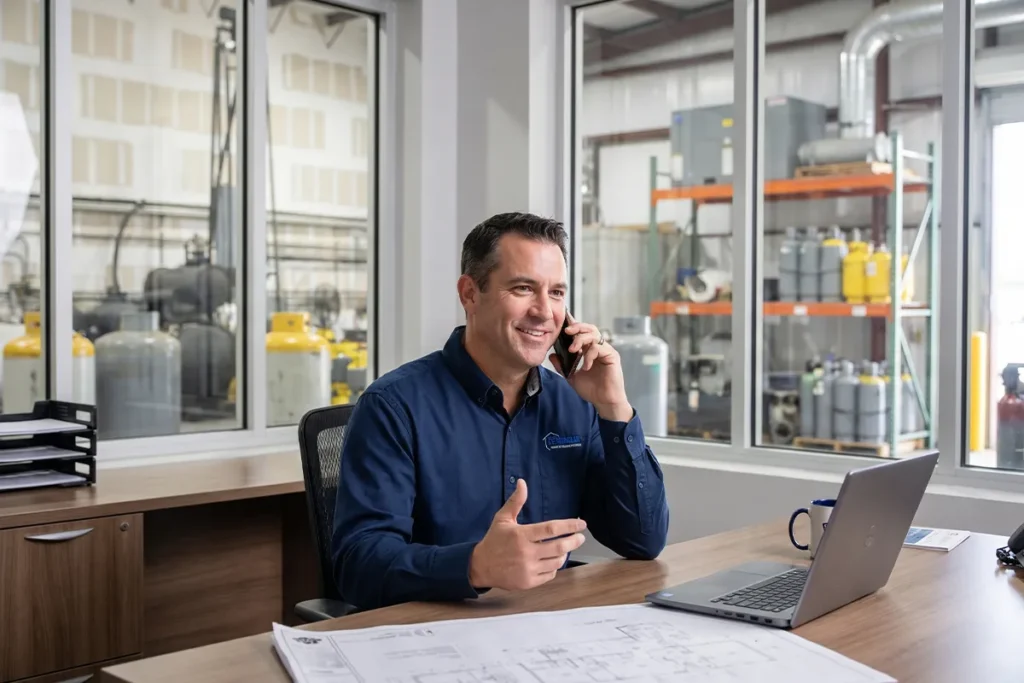
Chiller Refrigerant Recovery and Buyback for Decommissioning and Changeout Projects
EPA-Certified Reclaimer. Thousands of pounds per visit. Buyback on R11, R123, R22, and R134a.
Most chiller decommissioning jobs have a demolition schedule attached, and the refrigerant has to clear the building before anything else moves. Ameri-Ref handles that step directly: on-site recovery, full documentation, and a real buyback conversation based on what’s actually in the machine, because a centrifugal chiller that’s held 2,000 pounds of R123 for 30 years isn’t the same job as a residential call and shouldn’t be treated like one.
Mechanical contractors, school systems, hospital facilities, and HVAC demolition crews across Tampa Bay and Central Florida bring chiller jobs to Ameri-Ref because of what those jobs actually require: an EPA-Certified Reclaimer that holds its own HFC allowances, can handle mixed-gas tanks when the system wasn’t running pure refrigerant, and pays buyback in 30 days or less rather than routing the material through a broker chain that slows down the documentation and the check.
EPA-Certified Reclaimer (not a broker)
Top 200 HFC Allowance Holder Nationwide
In-House Fractionation and Mixed-Gas Separation
Payment in 30 Days or Less on Recovered Refrigerant
Chiller Decommissioning Is a Different Job From Standard HVAC Recovery
A residential condensate unit carries 3 to 10 pounds of refrigerant. A commercial rooftop unit runs 15 to 30. A large centrifugal chiller, the kind that cools a hospital wing, a school district’s central plant, or a corporate facility in the Westshore business district, typically holds somewhere between 1,500 and 3,500 pounds, and in some older installations the number runs higher. That volume changes everything about how the recovery gets handled, who can legally process the material, and what the buyback conversation looks like on the back end.
The Refrigerants in Florida's Older Chiller Stock
Florida’s commercial building inventory runs deep with centrifugal chiller systems that have been in continuous operation since the 1970s and 1980s. The dominant refrigerant types in that era’s equipment are R11 and R123: low-pressure refrigerants used in large, building-wide cooling installations. R11 production ended in 1994 under the Montreal Protocol. R123 is under phasedown from the AIM Act. Under the AIM Act phasedown, allowable HFC production falls to 60 percent of the 2022 baseline from 2024 through 2028, 30 percent from 2029 through 2033, and 15 percent from 2036 onward. Neither can be commercially manufactured as a new refrigerant anymore, so reclaimed supply is the only supply, and what comes out of a decommissioned chiller has real market value when handled by a reclaimer that can process it. Recovering those refrigerants from commercial systems is also a legal requirement under EPA regulations on refrigerant recovery, and handling them properly requires both certified personnel and a licensed reclaimer.
R134a shows up in higher-pressure centrifugal installations from the late 1990s onward, and R22 appears in smaller commercial systems and some packaged chiller configurations that came down later. Whatever combination ends up in the tank when the system shuts down, Ameri-Ref handles the full range.
Who Brings Chiller Jobs to Ameri-Ref
Mechanical contractors doing chiller changeouts are the most direct fit, typically swapping out an aging centrifugal unit at a Tampa-area hospital, school, or commercial building and needing the existing refrigerant cleared from the system before the new installation starts. That’s a volume recovery job with a schedule, not a call where you want to coordinate with a national broker and wait to find out if they can actually process what comes out of the machine.
HVAC demolition crews and scrap recyclers face a different version of the same problem: a full building gutting where the mechanical room needs to be cleared, the chillers come out with refrigerant still inside, and the material has to be documented and disposed of or sold before the equipment moves to the yard. Scrap contractors often don’t have a reclaimer relationship, so the refrigerant handling either gets subcontracted awkwardly or dealt with by whoever will return a call. Yards processing HVAC equipment on an ongoing basis can set up a standing account through our scrap metal and HVAC demolition recovery service instead of handling each load as a one-off.
School systems and institutional facilities, central plants for university campuses, hospital energy centers, county office buildings, occasionally replace chiller infrastructure on their own maintenance schedules, and the person coordinating that job is usually a facilities director or energy manager, not a mechanical contractor. Those conversations run differently: more documentation-conscious, often with environmental compliance requirements attached, and frequently with the need for written confirmation of how the refrigerant was handled after it left the site.
What Ameri-Ref Does on a Chiller Recovery Project
Three things happen in sequence on most chiller jobs: recovery, reclamation, and buyback. Older chiller systems frequently produce mixed-gas material, and when they do, there’s a fourth step, fractionation, that most reclaimers can’t handle without sending the tank to a third party.
On-Site Recovery at the Building
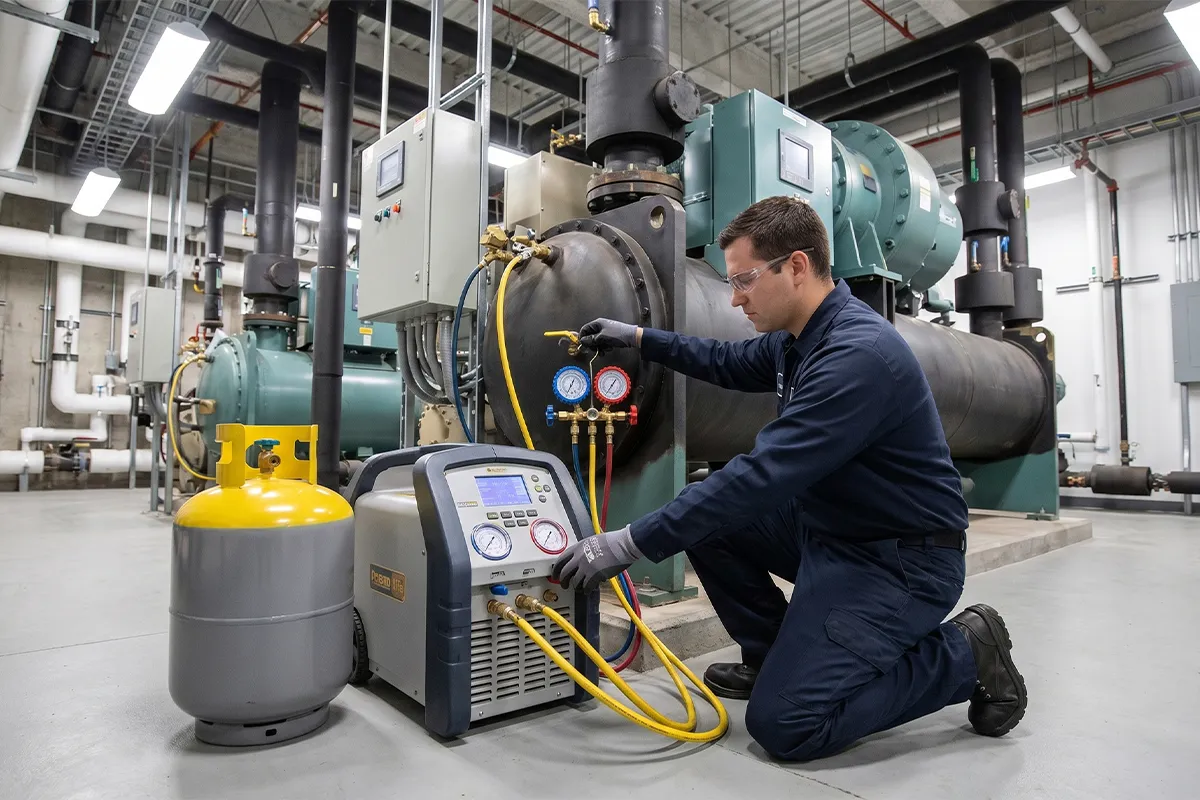
For large-volume jobs in the Tampa Bay and Central Florida market, Ameri-Ref dispatches on-site with certified recovery equipment scaled to commercial chiller work. The team extracts refrigerant directly from the system, handles the documentation chain from first cylinder to final disposition, and transports the material to our Bradenton facility under proper handling protocols in compliance with ASHRAE Standard 15. Every pound gets logged by type, volume, and source, which is part of what the EPA certification requires, and it’s also what protects the contractor or facility when compliance questions come up later.
Jobs where the volume doesn’t justify full on-site dispatch, or where the material has already been pre-recovered by the mechanical contractor’s own team, can be handled as inbound shipments to the Bradenton facility in DOT-compliant cylinders. Call ahead and we’ll walk through the logistics before anything moves.
Refrigerant Buyback on Chiller Material
R11, R123, R22, and R134a from chiller projects all carry buyback value, though how that plays out varies by refrigerant type and current market conditions. R11 and R123 are in consistent demand because reclaimed supply is the only legal supply for the large installed base of centrifugal equipment that still runs on both refrigerants. Production ended years ago, but the chillers didn’t stop needing service, so what comes out of a decommissioned system is genuinely useful material. R22 moves for similar reasons.
Payment on recovered refrigerant runs 30 days or less from receipt. Virgin refrigerant in sealed containers eligible for immediate resale settles faster, but we won’t promise 24 or 48-hour turnarounds for recovered material that needs to go through the reclamation process first. Most accounts settle well inside that 30-day outer limit, and we’ll be direct about the timeline when you call.
Pricing is custom to the job: refrigerant type, volume in pounds, purity, and logistics all factor in, and none of those variables translate cleanly to a published rate. Call for a quote and you’ll get a straight answer for your refrigerant and your project.
Mixed-Gas Separation and Reclamation
Older centrifugal chiller systems get topped off over time, and not always with the same refrigerant. A 1982 installation originally charged with R11 might have had R123 added at some point, or a field technician used a substitute during a period when the original refrigerant was in short supply. When that system finally comes down, the tank isn’t running a clean refrigerant type anymore, and that’s where most reclaimers run into problems they can’t solve on-site.
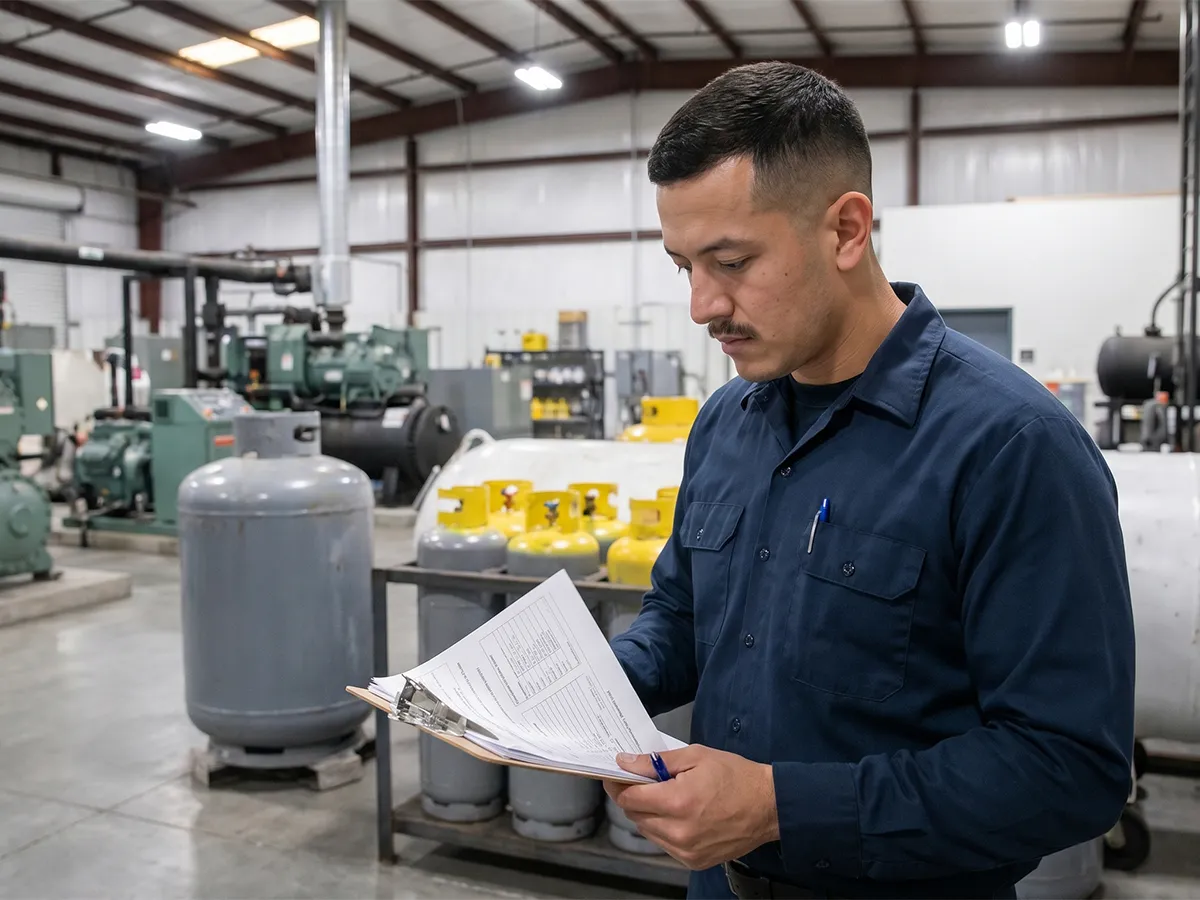
Ameri-Ref runs fractionation in-house: mixed gas comes in, gets separated by component at our Bradenton facility, and each stream processes through the reclamation system independently with full documentation covering the chain. No “we can’t take that” when the material from a Tampa demolition job doesn’t match a clean refrigerant type.
How a Chiller Recovery Project Runs With Ameri-Ref
The process is direct, and most contractors who’ve done it once describe the first call as considerably easier than they expected.
Step 1: Describe Your Project and What You Have
Call (941) 371-0300 or use the contact form. Tell us the refrigerant type, your estimated volume in pounds, where the job is, and your project timeline. If you’re not certain which refrigerant is in an older system, give us the equipment make and approximate installation year, and we can usually identify it before the project starts, which matters for recovery planning and for the buyback conversation. A phone call moves faster than a written inquiry on most project questions, and you’ll get a real answer the same day.
Step 2: On-Site Dispatch or Inbound Shipping
For large chiller jobs in the Tampa Bay and Central Florida market, Ameri-Ref dispatches on-site with the right equipment for the scope. For smaller volumes or pre-recovered material, the refrigerant ships to our Bradenton facility in DOT-compliant cylinders, and we’ll confirm the shipping requirements and documentation before anything moves. Both approaches produce a full, auditable documentation chain.
Step 3: Reclamation, Fractionation if Needed, and Payment
Refrigerant arriving at the facility goes through the reclamation process. Material that meets or is brought to AHRI 700 purity standards via independent laboratory testing is eligible for resale; material that doesn’t qualify processes under EPA-compliant disposal protocols. You receive documentation of the outcome either way, which matters for building permits, environmental compliance records, and in institutional projects, for reporting back to the commissioning authority or facilities management chain. Payment on recovered refrigerant follows within 30 days.
What Florida Chiller Demolition Contractors Find When They Search for a Reclaimer
Search for chiller refrigerant recovery in the Tampa Bay area and you’ll get a mixed list: general HVAC contractors with recovery listed as a secondary capability, national logistics companies that move refrigerant but don’t process it, and brokers who collect material and route it to a reclaimer the contractor never speaks to. Very few of those results are EPA-certified reclaimers operating their own reclamation facility, because building and maintaining that credential takes years and a level of infrastructure most regional operators don’t have. Ameri-Ref is one, and in Florida that’s a short list.
The HFC Allowance Piece Most Brokers Don't Mention
Under the AIM Act, purchasing and reselling recovered HFCs, including R22, R134a, and the refrigerants in Florida’s older chiller stock, requires a confirmed allowance holder. A broker without allowances is legally constrained in what they can do with your material downstream, and that limitation is rarely disclosed on the front end of the transaction. Ameri-Ref holds confirmed HFC allowances and ranks in the top 200 nationwide, so the downstream chain for your recovered refrigerant is legally complete from pickup through resale. Chris Mussey, Ameri-Ref’s owner and senior technician, frames why that matters on a changeout: “On a chiller job the refrigerant is often the only thing in the building still worth money. If your reclaimer can’t legally resell it under the AIM Act, that value disappears into a disposal line. We hold the allowances, so it comes back to you as a buyback check.”
Smaller Than the National Buyers, and That's the Point
Large corporate refrigerant buyers and national reclaimers have procurement approval cycles and customer service that operates through ticketing systems. For a mechanical contractor with a building scheduled for partial demo in two weeks, that’s not a workable operational reality. Ameri-Ref is built to move at the pace of a contractor relationship, and Chris Mussey or his team is reachable by phone rather than a support queue. Most contractors who’ve worked with a national buyer and then called Ameri-Ref notice the difference on the first call, mainly because someone picks up who already knows what a low-pressure centrifugal chiller is and can answer the project question directly.
Building the EPA certification, the HFC allowances, and the in-house fractionation capability took years, and they’re the reason Ameri-Ref can handle what a typical refrigerant broker can’t. What they don’t require is the corporate overhead and the multi-week procurement cycle that comes with a national operator.
Pricing on Chiller Refrigerant Buyback and Recovery
Why We Don't Post Rates
Buyback and recovery pricing for chiller jobs depends on too many job-specific factors to publish a number that means anything: refrigerant type, volume in pounds, purity, whether the material needs fractionation, distance to our Bradenton facility, and the recovery logistics all affect what makes sense. A 2,000-pound tank of R123 from a Westshore chiller changeout is priced differently than 400 pounds of R22 recovered from a commercial rooftop unit, and posting a generic rate would either mislead you or create an expectation we can’t stand behind.
Call (941) 371-0300 and you’ll get a direct answer for your situation: your refrigerant, your volume, and what the buyback picture looks like for your project. No mystery fees, no opening number that changes when the truck arrives.
Frequently Asked Questions About Chiller Refrigerant Recovery and Buyback
What refrigerant types does Ameri-Ref buy back from chiller decommissioning projects?
R11, R123, R22, and R134a are the refrigerant types most common in Florida chiller projects. R11 and R123 are the primary refrigerants in low-pressure centrifugal chillers from the 1970s through the early 2000s; R134a appears in higher-pressure systems installed later; R22 in commercial packaged configurations. If you are not certain which refrigerant is in the system, give us the equipment make and approximate installation year and we can usually identify it before the project starts. Getting the type right upfront changes both the recovery approach and the buyback conversation.
Can Ameri-Ref handle a chiller with mixed or blended refrigerant in the tank?
Yes, that’s what in-house fractionation covers. We separate it on-site, process each stream independently, and document the full chain. Older chiller systems in Florida frequently end up with blended refrigerant from top-offs over their service life, and mixed-gas tanks that a standard reclaimer would have to send to a third party come straight to us.
How does payment work on chiller refrigerant buyback?
Payment on recovered refrigerant is 30 days or less from receipt. Virgin refrigerant in sealed containers that can be resold as-is settles faster, though we won’t promise 24 or 48-hour turnarounds for recovered material that needs to go through the reclamation process. Thirty days is the firm outer limit and most accounts clear before that.
Does Ameri-Ref dispatch on-site to Tampa and Central Florida for chiller jobs?
Yes. Tampa Bay and Central Florida are within our active on-site service footprint for commercial and industrial-scale chiller work. Call (941) 371-0300 to confirm logistics for your specific project location, scope, and timeline.
What documentation does Ameri-Ref provide after the job?
Every job produces a full documentation chain: a log of material received by type, volume, and source; reclamation records; and disposition documentation showing how the refrigerant was handled, whether through reclamation for resale or EPA-compliant disposal. For institutional projects, including school systems, healthcare facilities, and government buildings, the documentation package often needs to feed into a broader environmental compliance file or a commissioning report, and we’ll confirm what format the records need to be in when you call. That documentation is part of the job, not an add-on.
What is the difference between an EPA-certified technician and an EPA-Certified Reclaimer?
A certified technician holds a personal license to recover refrigerant from a system on-site, which is a legal prerequisite before any commercial equipment can be serviced. The material they recover still has to go somewhere for processing. A certified reclaimer is the licensed facility that actually processes it back to purity standards, making it legally eligible for resale and reuse under the HFC phasedown under the AIM Act. Most HVAC companies and contractors you’d contact for chiller work hold the technician credential; very few are also EPA-Certified Reclaimers. Ameri-Ref holds both, so the material goes from your site to our facility without a third party in the documentation chain.
Chiller Refrigerant Recovery Service Area: Tampa Bay and Central Florida
Chiller work is part of Ameri-Ref’s broader refrigerant recovery service. On-site dispatch for chiller decommissioning and changeout projects covers the Tampa Bay and Central Florida corridor, with the primary focus on Hillsborough, Pinellas, Polk, Orange, and Osceola Counties. Most chiller volume comes out of the Tampa and Orlando metros. Sarasota and Manatee County facilities are in range as well, given our Bradenton base.
Contractors and facilities outside the on-site dispatch footprint can ship recovered refrigerant to the Bradenton facility in DOT-compliant cylinders, and national inbound shipping accounts are available for high-volume contractors running chiller projects across multiple markets. Call to discuss the logistics for your specific situation.
Get a Quote for Chiller Refrigerant Recovery and Buyback
Reach the Team Directly
When you contact Ameri-Ref, you reach the people doing the work, and you’ll get a straight answer the same day. Tell us the refrigerant type, your estimated volume in pounds, where the job is, and your timeline, and we’ll walk through what the recovery and buyback process looks like for your project.
Chiller decommissioning jobs, large-format changeout work, and HVAC demolition projects all start the same way, and a real answer is faster than most contractors expect going in.
- Direct EPA-Certified Reclaimer, not a broker
- Top 200 HFC allowance holder nationwide
- In-house mixed-gas fractionation
- Payment in 30 days or less on recovered refrigerant
- On-site service for Tampa Bay and Central Florida