
Mixed Gas Separation: Recover Value from Contaminated Refrigerant
That contaminated cylinder sitting in your shop isn’t trash — it’s recoverable product. American Refrigerants operates one of the only mixed gas separation facilities in the country, turning cross-contaminated refrigerant back into usable, EPA-certified gas.
One of 50 EPA-Certified Reclaimers in the U.S.
Separation Technology On-Site
HFC Allowance Holder
Bradenton, FL Facility
What Happens When Refrigerants Get Mixed?
It Happens More Often Than You'd Think
Cross-contamination is one of the most common problems in refrigerant recovery. A technician recovers R-22 from an older unit into a cylinder that still had traces of R-410A in it. Or a recovery machine pulls gas from a system that was previously topped off with the wrong refrigerant. Maybe a cylinder was mislabeled at some point and nobody caught it until the next tech ran an analysis.
However it happens, the result is the same: you’ve got a cylinder of mixed gas that nobody wants. The system it was meant for can’t use it. The next job can’t use it. And most reclaimers won’t touch it.
Most Reclaimers Won't Accept Mixed Gas
Here’s the reality that most HVAC contractors run into. You call a reclaimer to sell your recovered gas, and the first question they ask is about purity. If it’s not single-component and above a certain threshold, they don’t want it. Some will take it — but they’ll charge you a disposal fee to get rid of it. Others will flat-out refuse the cylinder.
That leaves contractors with two options: pay someone to destroy perfectly usable gas, or let those cylinders pile up in the corner of the shop. Neither option makes sense when the gas inside is still physically usable — it just needs to be separated first.
The Real Cost of Doing Nothing
Every contaminated cylinder sitting in your shop represents trapped value. R-22 alone — even when mixed — contains a refrigerant that hasn’t been manufactured since 2020 and can’t be purchased new anywhere in the country. That gas has real market value. Letting it sit there because it’s mixed with R-410A or R-407C is like throwing money in a storage cage and forgetting about it.
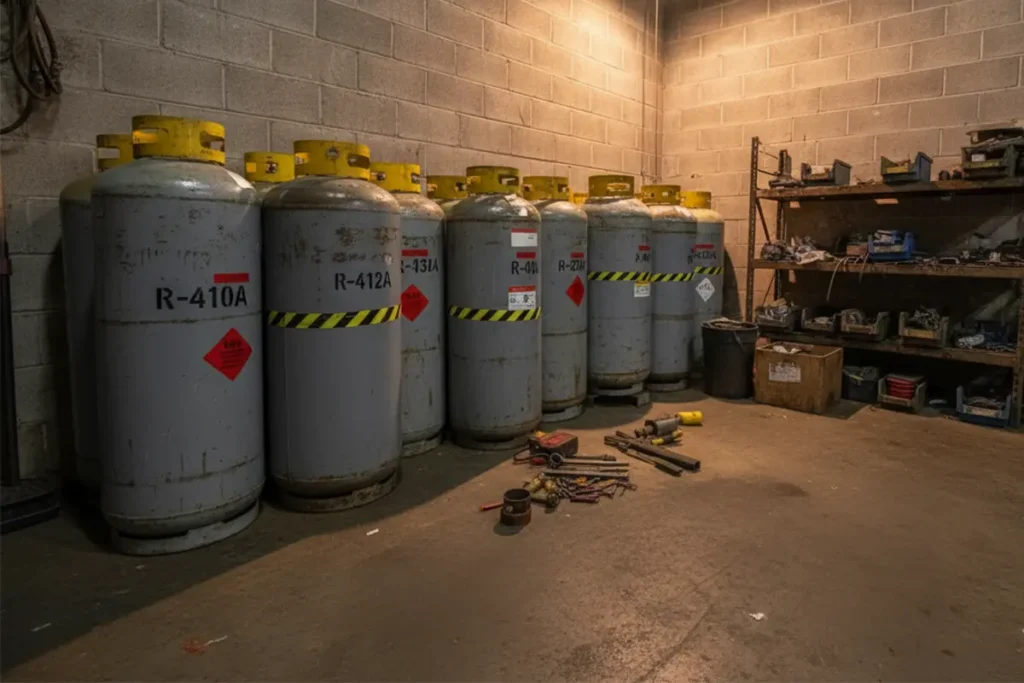
How We Separate Mixed Refrigerants — Step by Step
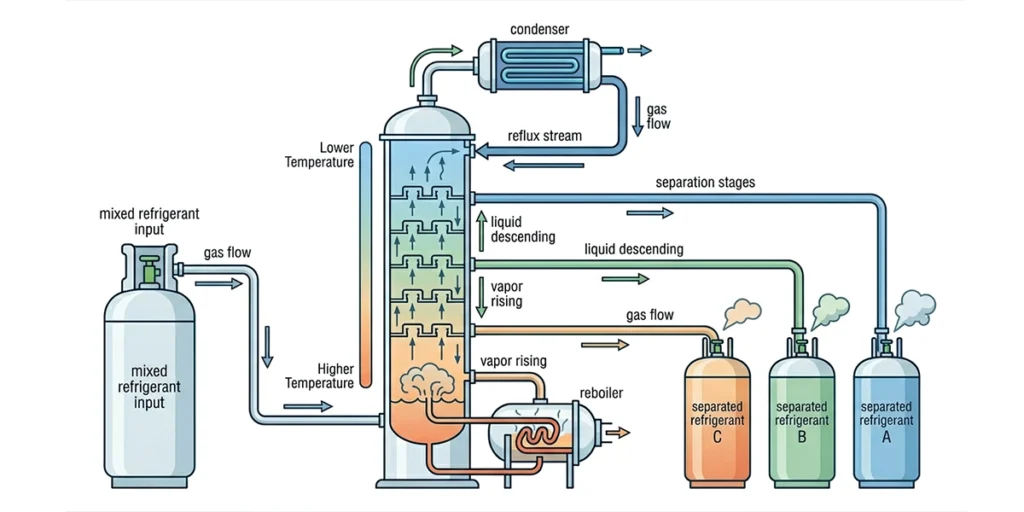
Mixed gas separation sounds complicated, but the concept is simple: different refrigerants boil at different temperatures. By carefully controlling temperature and pressure, we can coax each refrigerant out of a mixture one at a time, collect it separately, and certify it to ARI-700 purity standards. Here’s how the process works when you bring us a contaminated cylinder.
1
Analysis and Identification
Before we do anything, we test the gas. A sample is pulled from your cylinder and run through our gas chromatograph — the same type of equipment used in chemistry labs. This tells us exactly which refrigerants are in the mixture and in what proportions. If you’ve got a cylinder that’s 60% R-22 and 40% R-410A, we’ll know within minutes. If there’s a trace of R-407C or R-134a mixed in, we’ll see that too.
2
Secure & Certified Supply
Once we know what’s in the cylinder, the separation process begins. Our equipment uses fractional distillation — the same principle behind oil refining and whiskey distillation, just applied to refrigerant gases. Each refrigerant has a unique boiling point. R-22 boils at -41.4°F. R-410A boils at -61.0°F. R-134a boils at -15.1°F. By precisely controlling the temperature inside our separation columns, we pull each gas off the mixture at its specific boiling point and collect it in a separate, clean receiver.
3
Fast Delivery or Pickup
After separation, each recovered gas goes through our standard reclamation process. That means removing moisture, oil, acid, and particulates — bringing every batch up to ARI-700 specifications. This is the same purity standard that brand-new refrigerant ships at. We test every batch before it goes back into inventory.
Certification and Documentation
4
Every cylinder that comes out of our separation process gets a handling sheet showing exactly what was recovered, the final purity level, and the certification data. This isn’t a “trust us” situation — you get documentation that proves the gas meets spec. If you’re running it through your recovery equipment or selling it back to us, you’ve got paperwork backing it up.
5
Payment or Return
Here’s where it gets good. Once we’ve separated and certified the gas, you’ve got options. We can buy the recovered refrigerant from you at current market rates — and we pay fast, typically within 24-48 hours. Or, if you want the separated gas back for your own use, we offer a clean-and-return service. Either way, that “worthless” contaminated cylinder just turned into usable product or cash in your pocket.
Which Refrigerant Mixtures Can Be Separated?
he most common contamination scenario we see is R-22 mixed with R-410A. It happens when a tech recovers from an older R-22 system using a cylinder or machine that previously handled R-410A. But that’s far from the only mixture we can separate. Here are the gas combinations our facility handles:
Common Separation Scenarios We Handle
| Mixture | Why It Happens | Can We Separate It? | Recovered Gas |
|---|---|---|---|
| R-22 + R-410A | Cross-contamination during recovery from mixed-age systems | Yes | R-22 and R-410A (separately) |
| R-22 + R-407C | R-407C used as R-22 drop-in replacement; mixed during recovery | Yes | R-22 and R-407C components |
| R-22 + R-134a | Automotive and commercial systems cross-contamination | Yes | R-22 and R-134a (separately) |
| R-410A + R-407C | Similar system applications cause mixing during field recovery | Yes | R-410A and R-407C components |
| R-410A + R-134a | Recovery equipment cross-contamination between job types | Yes | R-410A and R-134a (separately) |
| R-22 + Multiple Gases | Legacy systems serviced over decades with various refrigerants | Yes — with analysis | Individual components based on mixture composition |
| R-12 + Other Gases | Vintage automotive and commercial equipment | Case by case | R-12 recovery when volume exceeds 50 lbs |
| R-11 + R-123 | Large chiller systems — centrifugal compressor refrigerants | Yes | R-11 and R-123 (separately, min 300 lbs) |
What We Can't Separate (And Why)
We’re transparent about limitations. Some mixtures are not economically viable to separate, and some we simply don’t handle:
- Ammonia-based refrigerants — We do not process ammonia. Different equipment, different safety requirements.
- R-454B reclamation — We do not currently reclaim R-454B. It’s a newer refrigerant and separation technology for it is still being developed.
- Very small quantities — Separation requires a minimum volume to be practical. If your cylinder has less than 30 lbs total, the process may not be cost-effective. Call us and we’ll evaluate your specific situation.
- Severely contaminated gas with high moisture or acid content — If the gas has been exposed to a major system failure (burnout), separation may not recover enough usable product. We’ll test first and give you an honest answer before proceeding.
The key difference: we’ll always test first and tell you what’s possible. Most reclaimers won’t even get that far — they just say no.
Why Mixed Gas Separation Changes the Economics of Refrigerant Recovery
Contaminated Doesn't Mean Worthless
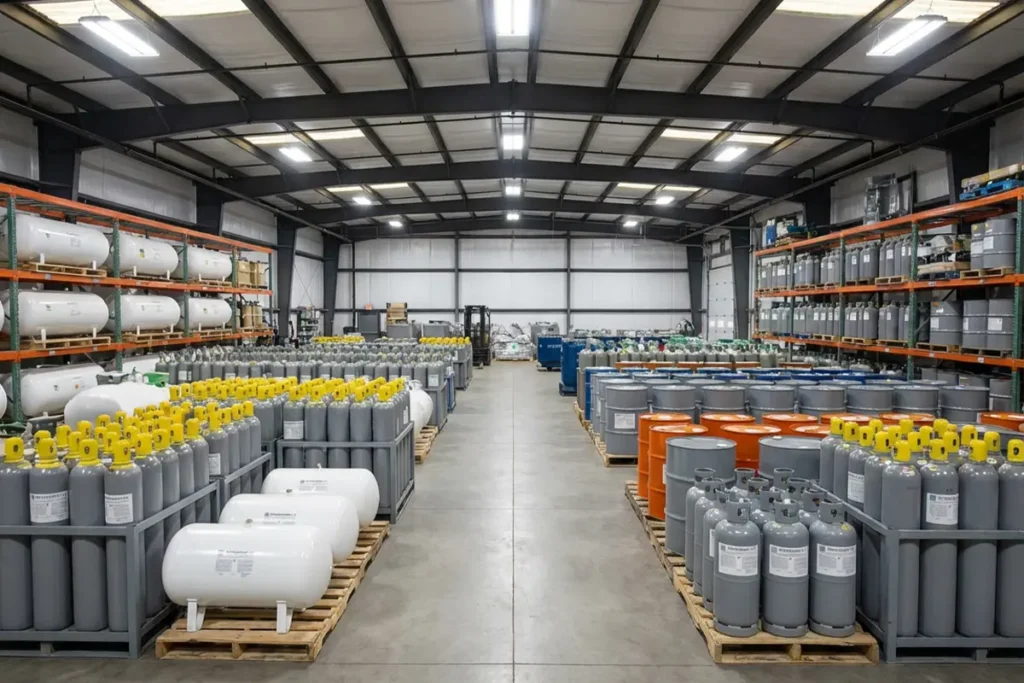
The biggest misconception in the HVAC industry is that a contaminated cylinder has zero value. That’s only true if nobody can separate it. When you work with a facility that has separation technology, every cylinder has potential value — because the individual gases inside it are still perfectly usable once they’re pulled apart.
Think about it this way: if you’ve got a 50-pound cylinder that’s 60% R-22 and 40% R-410A, you’re sitting on 30 pounds of R-22 — a refrigerant that hasn’t been manufactured since 2020 and commands premium pricing — and 20 pounds of R-410A. Both gases are in demand. Both can be recovered. And both have market value that you’d otherwise be throwing away.
R-22 Is Too Valuable to Waste
Here’s a number that should get your attention: R-22 production was permanently banned in the United States in January 2020. Every pound of R-22 that still exists in the country came from either existing stockpiles or reclamation. There’s no new supply — ever. That makes R-22 one of the most valuable refrigerants in circulation. Letting it sit in a contaminated cylinder is leaving money on the table.
R-11 and R-12 are in the same category. These refrigerants were phased out even earlier, and the only way to get them is through reclamation or separation from mixed cylinders. If you’ve got legacy gas mixtures containing any of these, there’s real money locked inside those tank
Turn a Storage Problem into Revenue
Most contractors we work with have at least a few cylinders sitting in their shop that they’ve been meaning to deal with for months — sometimes years. Contaminated gas, unknown mixtures, cylinders from decommissioned systems. Those cylinders take up space, create compliance headaches, and represent trapped value that could be converted to cash. Our separation process turns that backlog into revenue, clears your storage, and gets you paid fast.
A Capability That No Other Reclaimer Matches
Most Reclaimers Are Built for Single-Component Gas
Standard reclamation is relatively straightforward: you take a cylinder of R-410A, run it through filtration and distillation to remove moisture, oil, and acid, and certify it to ARI-700 specs. That's what the vast majority of the 50 EPA-certified reclaimers in the country do. And that's all they do.
Separation is a completely different operation. It requires specialized distillation columns, precise temperature control equipment, gas chromatography for analysis, and technicians who understand the thermodynamic properties of every refrigerant they're working with. It's not something you bolt onto an existing reclamation setup — it's purpose-built equipment that takes significant capital investment and deep technical expertise to operate.
The Clean-and-Return Option Nobody Else Offers
American Refrigerants still offers clean-and-return service — something competitors like A-Gas and Hudson have been phasing out. If you want your own gas back after separation, we can do that. We separate it, reclaim each component to ARI-700 specs, and return your cylinders to you filled with clean, certified, single-component gas. You sent us a mixed cylinder; you get back pure R-22 and pure R-410A in separate tanks. Nobody else in the industry is doing this for walk-in customers anymore.
One of 50 EPA-Certified Reclaimers — With Separation Technology
There are roughly 50 EPA-certified refrigerant reclaimers in the United States. Of those, only a handful have separation technology on-site. American Refrigerants is one of them. And unlike the larger corporate operations that only handle separation for bulk commercial accounts, we work directly with individual HVAC contractors, fleet managers, and mechanical service companies. There's no minimum account size and no long-term contract required. You've got contaminated gas — we'll separate it.
Located Right in Bradenton — Not a Freight Shipment Away
Most facilities with separation capability are located in industrial corridors hundreds of miles from where HVAC contractors actually work. American Refrigerants operates out of a facility at 2053 58th Ave Circle East in Bradenton, FL — right in the middle of Southwest Florida's busiest HVAC market. Contractors in Sarasota, Manatee, Hillsborough, Pinellas, and Charlotte counties can drop off contaminated cylinders locally instead of arranging freight shipments across state lines. For nationwide customers, we handle shipping logistics — but for local contractors, you're looking at a 15-minute drive, not a 3-day freight window.
Understanding Refrigerant Separation Technology
Fractional Distillation: The Core Principle
Refrigerant separation relies on fractional distillation — the same thermodynamic principle used in petroleum refining, chemical processing, and even beverage alcohol production. The concept is straightforward: every pure substance has a specific boiling point. When you heat a mixture of substances, the one with the lowest boiling point evaporates first. By capturing that vapor and condensing it separately, you isolate one component from the mixture.
With refrigerants, the boiling points are well-documented and highly predictable. R-22 boils at -41.4°F (-40.8°C). R-410A, which is itself a blend of R-32 and R-125, has a bubble point of -61.0°F (-51.6°C). R-134a boils at -15.1°F (-26.1°C). These differences — sometimes as small as 20 degrees — are enough for precision distillation equipment to separate the components cleanly.
Azeotropic vs. Zeotropic Mixtures
Not all refrigerant mixtures behave the same way during separation. Understanding the difference between azeotropic and zeotropic blends matters for predicting how separation will go:
• Zeotropic blends (like R-407C, which is R-32/R-125/R-134a) have components with different boiling points that separate relatively cleanly during distillation. These are generally easier to work with because each component “wants” to evaporate at its own temperature.
• Near-azeotropic blends (like R-410A, which is R-32/R-125 at 50/50) have components with very similar boiling points that evaporate almost simultaneously. These require more precise equipment and more distillation stages to achieve clean separation.
Our equipment handles both. The zeotropic mixtures tend to go faster; the near-azeotropic ones take more time and energy but still produce clean output. Either way, you get back individual, ARI-700 certified components.
Why ARI-700 Certification Matters
ARI-700 is the industry standard for reclaimed refrigerant purity. It specifies maximum allowable levels of moisture, acid, oil, non-condensable gases, and other contaminants. When we certify a batch to ARI-700, it means the gas is functionally identical to brand-new refrigerant. It can go into any system, pass any inspection, and perform exactly as the equipment manufacturer intended. Without this certification, you’re just guessing about what’s in the cylinder — and guessing with refrigerant can damage compressors, void warranties, and create safety hazards.
Who Benefits from Mixed Gas Separation?
HVAC Contractors
You're the front line. You recover gas from residential and commercial systems every day, and cross-contamination is an occupational hazard. Whether it's a residential split system, a commercial rooftop unit, or a multi-zone VRF setup, mixed gas happens. Instead of eating the loss or paying for disposal, send it to us. We'll separate it, and you get paid for the recovered product.
Mechanical Service Companies
Large-scale mechanical outfits managing commercial buildings, hospitals, and industrial facilities deal with legacy refrigerant systems spanning decades. Those systems often contain gas mixtures that have been topped off, cross-contaminated, or blended over years of service. We handle the complex separations that come with these environments — including large-volume chiller gases like R-11, R-12, and R-123.
Refrigerant Distributors and Wholesalers
If you're buying back recovered gas from contractors and encountering contaminated cylinders in your returns, we're your processing partner. Send us the mixed gas, and we'll return it as separated, certified individual components you can put back into your sales inventory.
Fleet Managers and Facility Operators
Managing refrigerant across a fleet of vehicles (R-134a, R-1234yf) or a campus of buildings (R-22, R-410A, R-407C) means occasional cross-contamination is inevitable. Our separation service lets you recover value from those incidents instead of writing off the gas as a loss.
Get a Quote for Refrigerant Separation
Tell Us What You've Got
Not sure if your gas can be separated? Send us the details and we’ll give you an honest answer — including what we think we can recover and what it’s worth. No commitment, no pressure. If we can’t help, we’ll tell you.
Frequently Asked Questions About Refrigerant Separation
We get these questions daily from HVAC contractors, facility managers, and distributors. If your question isn’t answered here, call us at (941) 371-0300 or fill out the form below — we respond within one business day.
Can you separate mixed R-22 and R-410A?
Yes. This is the most common separation we perform. R-22 and R-410A have significantly different boiling points, which makes them relatively straightforward to separate using fractional distillation. We analyze the mixture, separate the components, reclaim each to ARI-700 purity standards, and either buy the recovered gas from you or return it as clean, certified individual refrigerants.
What happens to my gas during the separation process?
First, we pull a sample and run it through our gas chromatograph to identify the exact composition. Then we feed the mixture through our separation columns, where controlled temperature and pressure pull each refrigerant off the mixture at its specific boiling point. Each component is collected separately, put through our reclamation process to remove moisture, oil, and contaminants, and certified to ARI-700 specifications.
How long does refrigerant separation take?
Processing time depends on the mixture complexity and the volume of gas. Simple two-component separations like R-22/R-410A typically take 1-3 business days after your cylinders arrive at our facility. Multi-component mixtures or large volumes may take longer. We give you an estimated timeline when we provide the initial quote.
Is there a minimum quantity for separation?
Separation requires a certain volume to be economically viable. Generally, we need at least 30 pounds of mixed gas to justify running the separation process. For chiller-grade refrigerants like R-11, R-123, and R-12, our minimum is typically higher — around 50 to 300 pounds depending on the specific gas. Call us with your specifics and we’ll tell you if it makes sense.
Do you pay for contaminated refrigerant?
In most cases, yes. If the gas contains recoverable refrigerants — especially high-value gases like R-22 — we’ll make you an offer based on the estimated recoverable product. We pay fast, typically within 24-48 hours of processing. The exact amount depends on the composition, purity after separation, and current market pricing for each component.
Can I get my separated gas returned to me instead of selling it?
Absolutely. We offer a clean-and-return service. We separate your mixed gas, reclaim each component to ARI-700 specifications, and return the separated, certified gas in clean cylinders. You send us one contaminated cylinder and get back two or more cylinders of pure, usable refrigerant. This option is popular with contractors who want to use the reclaimed gas on their own jobs.
What's the difference between separation and reclamation?
Reclamation takes a single-component refrigerant that’s degraded — meaning it has moisture, oil, acid, or non-condensable gases in it — and cleans it back to ARI-700 purity. Separation is the step before reclamation: taking a mixture of two or more different refrigerants and splitting them into individual components. After separation, each component goes through the reclamation process. American Refrigerants does both — separation AND reclamation — under one roof.
How does separation compare to chemical processing?
Refrigerant separation uses the same fundamental principles as chemical processing — specifically fractional distillation. The difference is scale and application. Industrial chemical processing plants handle thousands of compounds at massive volume. Our separation process is specifically engineered for refrigerant gases, with equipment calibrated to the boiling points and thermodynamic properties of HVAC refrigerants. The science is identical; the application is specialized.